The choice of an instrument for a child or an adult beginner is not just a list of “ease” ranked by family. The success of learning depends on parameters that general public guides often underestimate: the mechanical setup of the instrument, the actual pedagogical progression, and the material conditions of practice. Here, we discuss the technical points that make the difference between giving up after three months and sustainable practice.
Setup and lutherie: a poorly adjusted instrument sabotages learning
A violin with a bridge that is too high, a guitar with excessive string action, or a recorder with a shifted head joint produces an unpleasant sound. The beginner, whether a child or an adult, does not yet have the ear to distinguish an instrument defect from a technical error. They attribute the difficulty to themselves, not to the tool.
We regularly observe this pattern: a poorly maintained instrument discourages faster than an overly ambitious repertoire. A Parisian lutherie workshop confirms that a poorly adjusted violin produces a sound that is difficult to control, enough to discourage a child who does not yet know how to identify the source of the problem.
Before any purchase, ensure that the instrument has been set up by a professional. For bowed strings, the height of the bridge, the tension of the bow, and the quality of the rosin matter as much as the brand. For an entry-level digital keyboard, the weighted (or semi-weighted) touch conditions the transition to an acoustic piano. A keyboard without resistance creates striking habits incompatible with the mechanics of a real piano.
The technical criteria to check on any instrument intended for a beginner:
- String action or key resistance suitable for the player’s morphology, not just their age
- Tuning verified with a chromatic tuner, including on low-end new instruments that rarely come out of the factory in tune
- Absence of unwanted noises (rough frets on a guitar, stuck key on a flute, sticking key on a keyboard)
- Weight and size compatible with daily transport if the child attends music school
To explore a catalog of instruments designed for this audience, the Sklunk platform for beginners gathers references filtered by level and age.
Instrument rental for children: test before committing
Rental is the best option for a growing child. It allows for validating real interest before making an investment, and then changing size as their morphology evolves. For string instruments, sizing is done according to arm length and posture, not just age alone.
Switching to a larger size too early forces excessive finger stretching on the keys, which generates muscle tension and approximate intonation. Monthly rental avoids multiplying purchases with each size change.
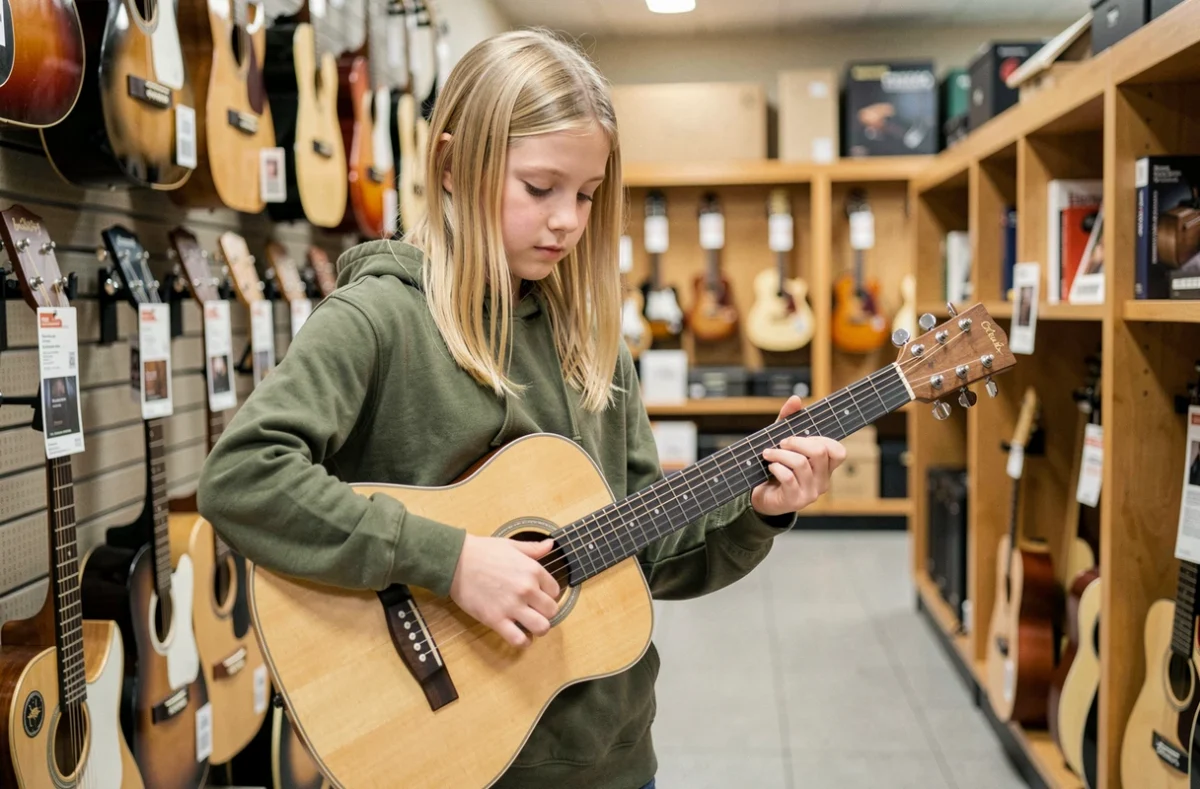
The same reasoning applies to the classical guitar. A 1/2 or 3/4 guitar is chosen by measuring the distance from elbow to fingertip, not by relying on an age range printed on the packaging. A tall seven-year-old may need a 3/4, while a petite nine-year-old remains comfortable with a 1/2.
Soprano ukulele and recorder: two safe bets under conditions
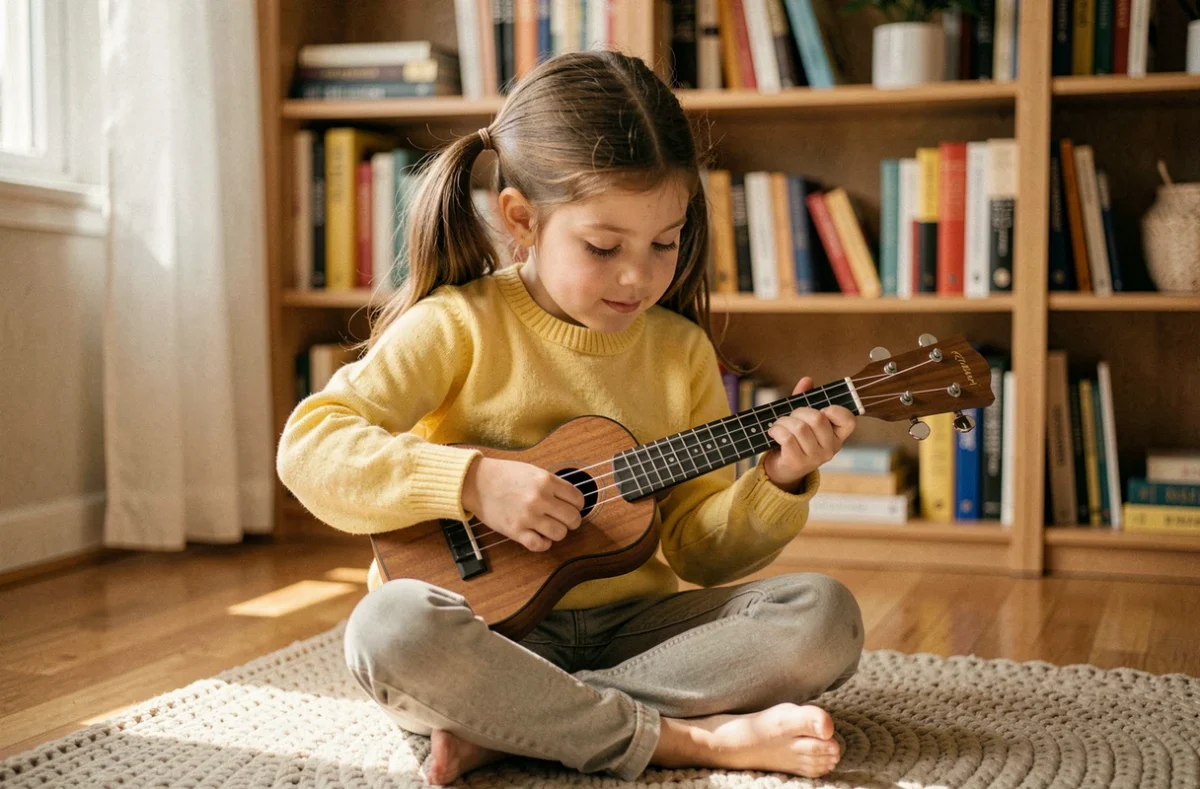
The soprano ukulele remains one of the most accessible string instruments for beginners. Four nylon strings, short neck, simple chords with two fingers. The limitation: models under twenty euros use friction tuners that go out of tune in minutes. We recommend closed gear tuners, even on a beginner’s instrument.
The soprano recorder (baroque or German fingering) offers immediate sound feedback. The German fingering simplifies some positions but complicates the transition to the transverse flute. The baroque fingering better prepares for the continuation of the instrumental journey.
Pedagogical progression: distinguishing awakening, collective, and instrumental lessons
The three stages do not overlap, and confusing them slows down progression. Before three years old, sensory exploration dominates: the child shakes, taps, listens, in a setting where parental presence is crucial. No technical learning is expected.
Between three and six years old, collective workshops develop rhythm, singing, and active listening. The goal is not to train an instrumentalist but to build an ear and a sense of tempo. Percussion instruments (tambourine, claves, wood-block) serve as pedagogical tools, not ends in themselves.
Structured instrumental learning begins when concentration and fine motor skills are sufficient, generally from six or seven years old. It is at this stage that the choice of a specific instrument truly makes sense.
Practice conditions: the room and the group matter as much as the instrument
A good instrument in a bad setting produces mediocre results. The often overlooked parameters:
- Groups tightened by age and level, to avoid a beginner being overwhelmed among second or third-year students
- Instruments provided in good working condition, tuned before each session
- Room without excessive reverb, which would make the sound confusing and prevent the child from hearing themselves play
- Moderate sound levels in amplified music workshops, to protect hearing
- Trial session offered before registration, allowing validation of the fit between the child, the teacher, and the format
We observe that schools offering trial lessons and collective formats for multi-instrument discovery achieve a significantly higher continuation rate. The child who has been able to try three or four instruments for a few weeks chooses with informed knowledge rather than on a visual impulse.
Piano or digital keyboard for beginners
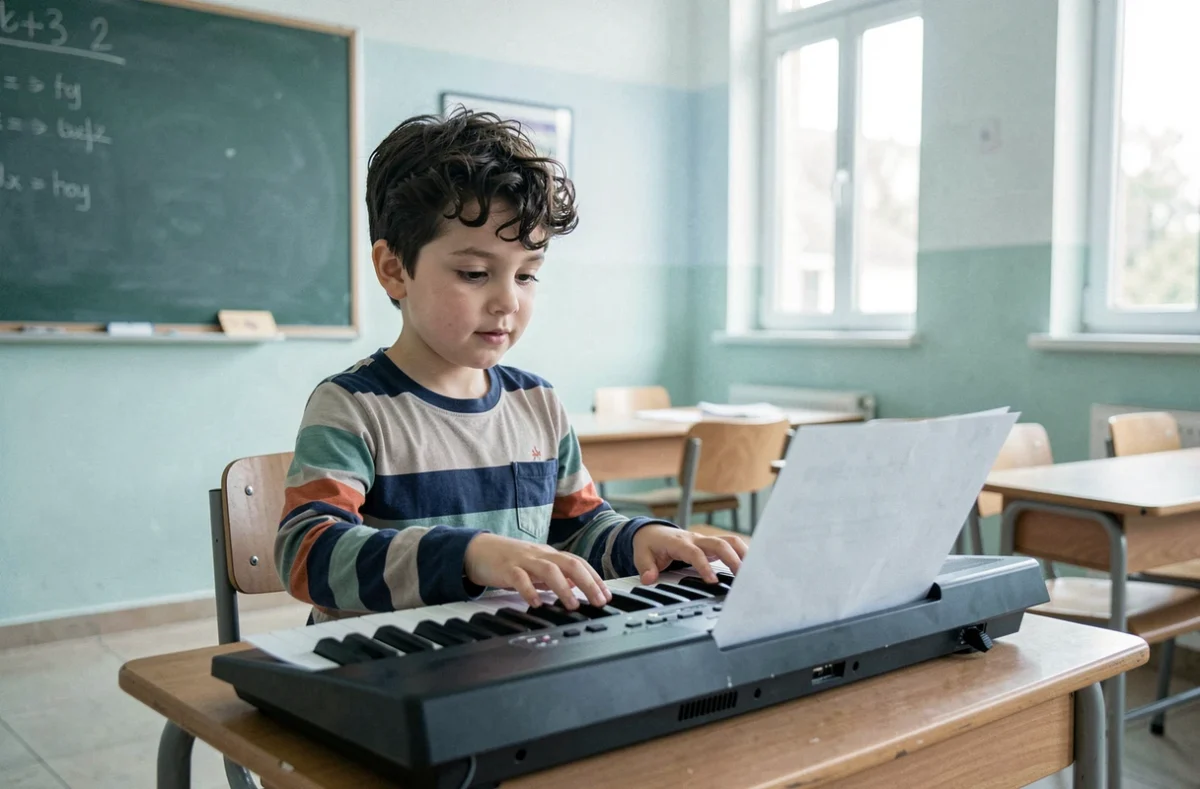
The piano remains the most requested instrument by families. For home learning, a digital keyboard with weighted touch and sufficient polyphony adequately replaces an upright piano, provided it does not fall below a certain threshold of mechanical quality. Keyboards with unweighted keys are suitable for musical awakening but hinder technical progression from the second year onward.
The format of the lesson also matters: a teacher who adapts the repertoire to the student’s tastes maintains motivation much longer than a rigid method imposing only classical music on a child drawn to pop or jazz.
The instrument suitable for children and beginners does not exist in itself. What exists is a properly sized instrument, well adjusted, integrated into a coherent pedagogical progression, and practiced in an environment designed for learning. Every link matters, and the weakest one determines the outcome.